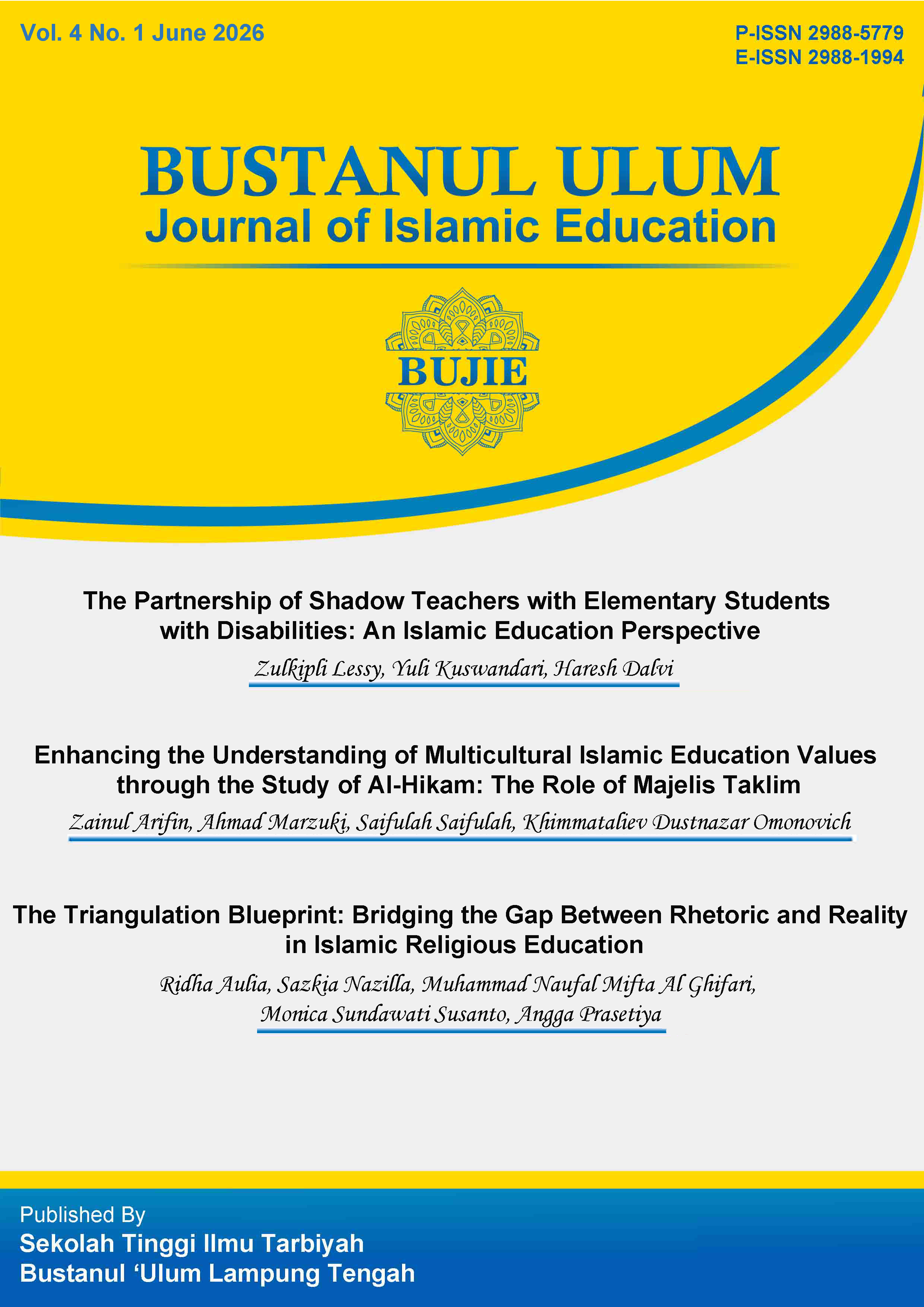
The Triangulation Blueprint: Bridging the Gap Between Rhetoric and Reality in Islamic Religious Education
DOI:
https://doi.org/10.62448/bujie.v4i1.573Keywords:
Observational Assessment, Affective, Islamic Religious Education, Independent Learning, Triangulation of AssessmentAbstract
The transformation of education in the era of Independent Learning necessitates robust character development. However, affective assessment in Islamic Religious Education (PAI) often becomes limited to administrative formalities, risking the reduction of the curriculum’s vision to rhetoric without meaningful behavioral change. This study critically examines the challenges and strategies in implementing affective observation assessment at SMP Negeri 1 Baitussalam, Aceh Besar. Employing a qualitative case study, data were gathered through observation, documentation, and in-depth interviews with PAI teachers and students. Analysis utilized Krathwohl’s Affective Taxonomy and Character Education Theory. Findings indicate that value internalization is hindered by subjectivity bias, students’ psychological barriers to honest self-reflection, social conflicts in peer-assessment, and the “name passenger” phenomenon in group tasks. Instrument triangulation—integrating self-assessment, peer assessment, and teacher journals—emerges as an effective strategy, minimizing data manipulation and fostering internalization of values. This triangulation model is recommended as an authentic standard to strengthen character education in the digital era.
Downloads
References
Adawiah, R. (2023). Teacher’s Constraints and Challenges in Implementing Student Attitude Assessment in Junior High School. Open Education Studies, 5(1), pp. 20220204. https://doi.org/10.1515/edu-2022-0204
Alenezi, M., Wardat, S., & Akour, M. (2023). The Need of Integrating Digital Education in Higher Education: Challenges and Opportunities. Sustainability, 15(6), 4782. https://doi.org/10.3390/su15064782
Al-Hendawi, M., Hussein, E., & Darwish, S. (2025). Direct observation systems for child behavior assessment in early childhood education: A systematic literature review. Discover Mental Health, 5(1), 21. https://doi.org/10.1007/s44192-025-00139-z
Almufarreh, A., & Arshad, M. (2023). Promising Emerging Technologies for Teaching and Learning: Recent Developments and Future Challenges. Sustainability, 15(8), 6917. https://doi.org/10.3390/su15086917
Al-Rashidi, A. H., Asif, M., Vanani, M. G., & Aberash, A. (2022). Learner-oriented assessment (LOA) practice: The comparative study of self-assessment, peer assessment, and teacher assessment on EFL learners’ writing complicity, accuracy, and fluency (CAF), speaking CAF, and attitude. Language Testing in Asia, 12(1), 59. https://doi.org/10.1186/s40468-022-00209-x
Amal Ebrahem Hassan Bedalla & Mardiya Abobaker Yousef Elzouki. (2023). Participatory Approach in Teaching Reading Comprehension. Bani Waleed University Journal of Humanities and Applied Sciences, 8(5), 162-171. https://doi.org/10.58916/jhas.v8i5.64
Anwar, S., & Menekşe, M. (2021). Context and Implications Document for: A systematic review of observation protocols used in postsecondary STEM classrooms. Review of Education, 9(1), 121–123. https://doi.org/10.1002/rev3.3236
Asrial, A., Syahrial, S., Kurniawan, D. A., Insani Putri, F., Perdana, R., Rahmi, R., Susbiyanto, S., & Aldila, F. T. (2024). E-Assessment for Character Evaluation in Elementary Schools. Qubahan Academic Journal, 4(3), 806–822. https://doi.org/10.48161/qaj.v4n3a595
Aulia, R., Prastowo, A., Fathunnajih, F., & Ayu Saputri, D. (2024). Implementing Moral Education Through Al-Ghazali’s Perspective In Islamic Studies: A Case Study At Elementary School In Yogyakarta. Lentera Pendidikan : Jurnal Ilmu Tarbiyah Dan Keguruan, 27(1), 243–259. https://doi.org/10.24252/lp.2024v27n1i15
Birkeland, J., Baste, V., & Eriksen Ødegaard, E. (2020). Observation as a professional tool in Norwegian kindergartens and kindergarten teacher education. Cogent Education, 7(1), 1789381. https://doi.org/10.1080/2331186X.2020.1789381
Bulkani, B., Riadin, A., Ni’mah, N., & Setiawan, M. A. (2025). Impact of holistic learning models on character development: A systematic review. The Education and Science Journal, 27(5), 111–141. https://doi.org/10.17853/1994-5639-2025-5-111-141
Burgess, S., Rawal, S., & Taylor, E. S. (2021). Teacher Peer Observation and Student Test Scores: Evidence from a Field Experiment in English Secondary Schools. Journal of Labor Economics, 39(4), 1155–1186. https://doi.org/10.1086/712997
Butvilas, T., Bubnys, R., Colomer, J., & Cañabate, D. (2022). Dependence of Socio-Emotional Competence Expression on Gender and Grade for K5–K12 Students. Education Sciences, 12(5), 341. https://doi.org/10.3390/educsci12050341
Chen, C., An, Q., Zheng, L., & Guan, C. (2022). Sustainability Literacy: Assessment of Knowingness, Attitude and Behavior Regarding Sustainable Development among Students in China. Sustainability, 14(9), 4886. https://doi.org/10.3390/su14094886
Connor, C. M., Adams, A., Zargar, E., Wood, T. S., Hernandez, B. E., & Vandell, D. L. (2020). Observing individual children in early childhood classrooms using Optimizing Learning Opportunities for Students (OLOS): A feasibility study. Early Childhood Research Quarterly, 52, 74–89. https://doi.org/10.1016/j.ecresq.2019.10.001
Denessen, E., Hornstra, L., Van Den Bergh, L., & Bijlstra, G. (2022). Implicit measures of teachers’ attitudes and stereotypes, and their effects on teacher practice and student outcomes: A review. Learning and Instruction, 78, 101437. https://doi.org/10.1016/j.learninstruc.2020.101437
Dewi, M. R., & Arifin, Z. (2024). Analysis of 21st Century Skills in the Implementation of Project Based Learning in Biology Learning Merdeka Curriculum. Jurnal Penelitian Pendidikan IPA, 10(4), 2118–2128. https://doi.org/10.29303/jppipa.v10i4.5941
Díez-Palomar, J., García-Carrión, R., Hargreaves, L., & Vieites, M. (2020). Transforming students’ attitudes towards learning through the use of successful educational actions. PLOS ONE, 15(10), e0240292. https://doi.org/10.1371/journal.pone.0240292
Dignath, C., & Veenman, M. V. J. (2021). The Role of Direct Strategy Instruction and Indirect Activation of Self-Regulated Learning—Evidence from Classroom Observation Studies. Educational Psychology Review, 33(2), 489–533. https://doi.org/10.1007/s10648-020-09534-0
Doabler, C. T., Clarke, B., Kosty, D., Turtura, J. E., Sutherland, M., Maddox, S. A., & Smolkowski, K. (2021). Using Direct Observation to Document “Practice-Based Evidence” of Evidence-Based Mathematics Instruction. Journal of Learning Disabilities, 54(1), 20–35. https://doi.org/10.1177/0022219420911375
Dr. Shamali Madhav Thorat. (2025). Beyond Exams: Designing Competency-Based Assessments for the 21st Century Learner. International Journal of Advanced Research in Science, Communication and Technology, 18–27. https://doi.org/10.48175/IJARSCT-25603
Eddy, L. H., Bingham, D. D., Crossley, K. L., Shahid, N. F., Ellingham-Khan, M., Otteslev, A., Figueredo, N. S., Mon-Williams, M., & Hill, L. J. B. (2020). The validity and reliability of observational assessment tools available to measure fundamental movement skills in school-age children: A systematic review. PLOS ONE, 15(8), e0237919. https://doi.org/10.1371/journal.pone.0237919
Eka Herlina, F. S. S., Lina Novita,. (2023). Analysis Of 21st Century Skills Through Thematic Learning In Elementary Schools. Jurnal Pendidikan Dan Pengajaran Guru Sekolah Dasar (JPPGuseda), 6(1), 119–122. https://doi.org/10.55215/jppguseda.v6i1.7526
Estrada, M., Monferrer, D., Rodríguez, A., & Moliner, M. Á. (2021). Does Emotional Intelligence Influence Academic Performance? The Role of Compassion and Engagement in Education for Sustainable Development. Sustainability, 13(4), 1721. https://doi.org/10.3390/su13041721
Guo, J., Tang, X., Marsh, H., Parker, P. D., Basarkod, G., Sahdra, B. K., Ranta, M., & Salmela-Aro, K. (2021). The Roles of Social-Emotional Skills in Students’ Academic and Life Success: A Multi-Informant, Multi-Cohort Perspective. Journal of Personality and Social Psychology PsyArXiv. https://doi.org/10.31234/osf.io/ahg8p
Hadi, A., Marniati, M., Ngindana, R., Kurdi, M. S., Kurdi, M. S., & Fauziah, F. (2023). New Paradigm of Merdeka Belajar Curriculum in Schools. AL-ISHLAH: Jurnal Pendidikan, 15(2), 1497–1510. https://doi.org/10.35445/alishlah.v15i2.3126
Haleem, A., Javaid, M., Qadri, M. A., & Suman, R. (2022). Understanding the role of digital technologies in education: A review. Sustainable Operations and Computers, 3, 275–285. https://doi.org/10.1016/j.susoc.2022.05.004
Halimi, K., & Seridi-Bouchelaghem, H. (2021). Students’ competencies discovery and assessment using learning analytics and semantic web. Australasian Journal of Educational Technology, 37(5), 77–97. https://doi.org/10.14742/ajet.7116
Hidayat, M. T., Suryadi, S., Latifannisa, N., Sari, S. N., & Rino, R. (2025). Evolution of The Education Curriculum in Indonesia. Journal of Innovation in Educational and Cultural Research, 6(2), 381–395. https://doi.org/10.46843/jiecr.v6i2.1312
Hsu, W.-C., Fuh, L.-J., & Liao, S.-C. (2024). Tickling the heart: Integrating social emotional learning into medical education to cultivate empathetic, resilient, and holistically developed physicians. Frontiers in Medicine, 11, 1368858. https://doi.org/10.3389/fmed.2024.1368858
Hunaepi, H., Suharta, I. G. P., & Ganesha University of Education. (2024). Transforming Education in Indonesia: The Impact and Challenges of the Merdeka Belajar Curriculum. Path of Science, 10(6), 5026–5039. https://doi.org/10.22178/pos.105-31
Husnul Haq & Wakidi. (2024). Evaluation of the Implementation of the Merdeka Belajar Curriculum in Secondary Schools in the Digital Era. International Journal of Post Axial: Futuristic Teaching and Learning, 215–228. https://doi.org/10.59944/postaxial.v2i4.391
Johnson, E. S., Zheng, Y., Crawford, A. R., & Moylan, L. A. (2021). The Relationship of Special Education Teacher Performance on Observation Instruments with Student Outcomes. Journal of Learning Disabilities, 54(1), 54–65. https://doi.org/10.1177/0022219420908906
Komariah, N., & Nihayah, I. (2023). Improving The Personality Character of Students Through Learning Islamic Religious Education. At-Tadzkir: Islamic Education Journal, 2(1), 65–77. https://doi.org/10.59373/attadzkir.v2i1.15
Korea, M. D., Alexopoulos, P., & Department of Primary Education, University of the Aegean, Rhodes, Greece. (2023). Observation Methodology, Informal Pedagogical Assessment, and School Integration in a Student with Autism Spectrum Disorder. International Journal of Social Science and Human Research, 06(02). https://doi.org/10.47191/ijsshr/v6-i2-02
Kuo, Y.-K., Batool, S., Devi, S., Tahir, T., & Yu, J. (2024). Exploring the impact of emotionalized learning experiences on the affective domain: A comprehensive analysis. Heliyon, 10(1), e23263. https://doi.org/10.1016/j.heliyon.2023.e23263
Kurniawan, I. G. W. A. (2024). Fostering independent learners: Kurikulum Merdeka, Merdeka Belajar, the student-centred learning approach and pedagogical reform. Journal of Language, Literature, Social and Cultural Studies, 1(3), 210–217. https://doi.org/10.58881/jllscs.v1i3.100
Kurniawan S. Djibran, A., Subiyanto, P., Wakhudin, W., & Sri Rahayu, N. (2024). Transforming Education in The Digital Age: How Technology Affects Teaching and Learning Methods. Journal of Pedagogi, 1(3), 141–155. https://doi.org/10.62872/ksq9jc13
Li, J., Xue, E., Li, C., & He, Y. (2023). Investigating Latent Interactions between Students’ Affective Cognition and Learning Performance: Meta-Analysis of Affective and Cognitive Factors. Behavioral Sciences, 13(7), 555. https://doi.org/10.3390/bs13070555
Li, W. (2023). Indicating Classroom Observation Protocols in PBL Studies. SHS Web of Conferences, 174, 01007. https://doi.org/10.1051/shsconf/202317401007
Liu, C., Zowghi, D., Kearney, M., & Bano, M. (2021). Inquiry‐based mobile learning in secondary school science education: A systematic review. Journal of Computer Assisted Learning, 37(1), 1–23. https://doi.org/10.1111/jcal.12505
Michael, T., Musa, M., Bisaso, S. M., & Madinah, N. (2024). Social Values and Students Holistic Education among Selected Secondary Schools in Mbale District, Uganda. International Journal of Innovative Science and Research Technology (IJISRT), 1908–1920. https://doi.org/10.38124/ijisrt/IJISRT24AUG1447
Milles, M. B., Huberman, A. M., & Saldana. (2014). Qualitative Data Analysis, A Methods Sourceboo (R. Tjeptjep, Trans.; 3rd ed.). New York: Sage publications.
Minh, T. K., Dung, D. T., Hue, H. T. K., Giang, N. T. H., Cui, V., & O’Leary, M. (2023). Sorting or supporting teachers? An exploration of the imbalanced role of classroom observation in the development and assessment of Vietnamese secondary schoolteachers. PRACTICE, 5(3), 220–236. https://doi.org/10.1080/25783858.2023.2177187
Mohammed Abdullah AL-Balushi, H., & Saazai Bt Mat Saad, N. (2021). Improving Classroom Observation through Training: A qualitative Study in College of Technology in Oman. Arab World English Journal, 12(4), 415–425. https://doi.org/10.24093/awej/vol12no4.27
Muchson, M. (2023). Application of the Project Based Learning Model to Improve 21st Century Competence 4C. International Journal of Research and Review, 10(1), 654–665. https://doi.org/10.52403/ijrr.20230173
Müller, F., Denk, A., Lubaway, E., Sälzer, C., Kozina, A., Perše, T. V., Rasmusson, M., Jugović, I., Nielsen, B. L., Rozman, M., Ojsteršek, A., & Jurko, S. (2020). Assessing social, emotional, and intercultural competences of students and school staff: A systematic literature review. Educational Research Review, 29, 100304. https://doi.org/10.1016/j.edurev.2019.100304
Ndihokubwayo, K., Uwamahoro, J., & Ndayambaje, I. (2020). Implementation of the Competence-Based Learning in Rwandan Physics Classrooms: First Assessment Based on the Reformed Teaching Observation Protocol. Eurasia Journal of Mathematics, Science and Technology Education, 16(9), em1880. https://doi.org/10.29333/ejmste/8395
Nuraisyah, N., Marsuki Ar, U., Insani, A. H., Herman, H., & Rusmayadi, R. (2024). Teacher’s Approach in Increasing the Interpersonal Intelligence of Children aged 5-6 years in Cingkang Village. EduLine: Journal of Education and Learning Innovation, 4(3), 318–324. https://doi.org/10.35877/454RI.eduline2765
Nurlaelah, N., Syahid, A., Fuady, M. I. N., & Lestari, M. F. (2021). Improving Learning Activities and Outcomes of Students by Application of Observation-based Learning. Universal Journal of Educational Research, 9(3), 479–486. https://doi.org/10.13189/ujer.2021.090307
OECD. (2024). Transforming education in Indonesia: Examining the landscape of current reforms (OECD Education Policy Perspectives No. 88; OECD Education Policy Perspectives, Vol. 88). https://doi.org/10.1787/9ff8d407-en
O’Leary, M. (2024). Rethinking teachers’ professional learning through unseen observation. Professional Development in Education, 50(6), 1162–1175. https://doi.org/10.1080/19415257.2022.2125551
Page, L. C., Lenard, M. A., & Keele, L. (2020). The Design of Clustered Observational Studies in Education. AERA Open, 6(3), 2332858420954401. https://doi.org/10.1177/2332858420954401
Ponomariovienė, J., Jakavonytė-Staškuvienė, D., & Torterat, F. (2025). Implementing Competency-Based Education Through the Personalized Monitoring of Primary Students’ Progress and Assessment. Education Sciences, 15(2), 252. https://doi.org/10.3390/educsci15020252
Pranjia, U. R., Ulpa, I. M., & Manthika, S. P. (2020). Implementasi Sikap Spiritual Dan Sikap Sosial Dalam Sistem Full Day School. Jurnal Pendidikan Islam, 11(1), 31–43. https://doi.org/10.22236/jpi.v11i1.5032
Puspita, R. R., & Suyatno, S. (2020). Teacher Observation Assessment for Primary Education. Eternal (English Teaching Journal), 11(2). https://doi.org/10.26877/eternal.v11i2.7565
Puspitasari, N., Relistian. R, L., & Yusuf, R. (2022). Peran Pendidikan Agama Islam Terhadap Pembentukan Karakter Religius Peserta Didik. Atta’dib Jurnal Pendidikan Agama Islam, 3(1), 57–68. https://doi.org/10.30863/attadib.v3i1.2565
Rahman, S., Agustami, E., Effendi, S., Padang, R., & Guchi, Z. (2024). The Impact of Islamic Religious Education on the Development of Social Character Among Secondary School Students. International Journal of Educational Research Excellence (IJERE), 3(1), 421–427. https://doi.org/10.55299/ijere.v3i1.881
Rocha, T., Mendes, C., & Wardhani, W. D. L. (2025). Assess the Impact of a Project-Based Learning Approach on the Development of 21st Century Skills. Lingeduca: Journal of Language and Education Studies, 4(1), 32–41. https://doi.org/10.70177/lingeduca.v4i1.2226
Sandiyani, N. L. K., Padmadewi, N. N., & Artini, L. P. (2023). Teachers’ Perception Toward Assessing Students Based On 21st-Century Skills. International Journal of Language and Literature, 6(3), 126–132. https://doi.org/10.23887/ijll.v6i3.29224
Saripudin, D., Komalasari, K., Value-Based Digital Storytelling Learning Media to Foster Student Character. International Journal of Instruction, 14(2), 369–384. https://doi.org/10.29333/iji.2021.14221a
Sarwadi, S., & Nashihin, H. (2023). Character Education between The Western Context and Islamic Perpective. Al Hikmah: Journal of Education, 4(1), 1. https://doi.org/10.54168/ahje.v4i1.146
Shui Ng, W., & Yu, G. (2023). Students’ attitude to peer assessment process: A critical factor for success. Interactive Learning Environments, 31(5), 2967–2985. https://doi.org/10.1080/10494820.2021.1916762
Siswanto, M. B. E., Suryanti, , Nursalim, M, Wahida, S. N (2025). Development of transformative reflexive empowering character-building learning model: A case study of Pancasila student profile at elementary schools. Perspectives of Science and Education, 72(6), 458–469. https://doi.org/10.32744/pse.2024.6.28
Siu, O., Lui, K. F. H., Huang, Y., Ng, T. K., & Yeung, W. L. V. (2024). An efficient, reliable and valid assessment for affective states during online learning. Scientific Reports, 14(1), 15768. https://doi.org/10.1038/s41598-024-66974-2
Sriyanta, S., Mujahid, K., & Suranto, Muh. (2025). Pendidikan Holistik dalam Pengembangan Karakter Siswa. TSAQOFAH, 5(2), 1639–1646. https://doi.org/10.58578/tsaqofah.v5i2.4899
Suhirman, S., Yusuf, Y., Muliadi, A., & Prayogi, S. (2020). The Effect of Problem-Based Learning with Character Emphasis toward Students’ Higher-Order Thinking Skills and Characters. International Journal of Emerging Technologies in Learning (iJET), 15(06), 183. https://doi.org/10.3991/ijet.v15i06.12061
Sunandang, E. R., Heryatun, Y., & Anita, A. (2023). The Use of Alternative Assessment (Observation) and Student Learning Outcomes In English Classrooms: How Do They Correlate? Journal of English Language Teaching, 8(1), 53. https://doi.org/10.30998/scope.v8i1.17387
Tabroni, I., Marlina, L., & Maesaroh, S. (2022). Islamic Religious Education Learning in Forming an Islamic Personal Character. L’Geneus : The Journal Language Generations of Intellectual Society, 11(1), 13–19. https://doi.org/10.35335/geneus.v11i1.2180
Tafsir, A. (2009). Filsafat Ilmu Menguurai Ontologi, Epistimologi dan Aksiologi Pengetahuan. PT. Remaja Rosdakarya.
Teasdale, R., Ryker, K., Viskupic, K., Czajka, C. D., & Manduca, C. (2020). Transforming education with community-developed teaching materials: Evidence from direct observations of STEM college classrooms. International Journal of STEM Education, 7(1), 56. https://doi.org/10.1186/s40594-020-00251-2
Thomas, K. J., Da Cunha, J., & Santo, J. B. (2022). Changes in Character Virtues are Driven by Classroom Relationships: A Longitudinal Study of Elementary School Children. School Mental Health, 14(2), 266–277. https://doi.org/10.1007/s12310-022-09511-8
Thornhill-Miller, B., Camarda, A., Mercier, M., Burkhardt, J.-M., Morisseau, T., Bourgeois-Bougrine, S., Vinchon, F., El Hayek, S., Augereau-Landais, M., Mourey, F., Feybesse, C., Sundquist, D., & Lubart, T. (2023). Creativity, Critical Thinking, Communication, and Collaboration: Assessment, Certification, and Promotion of 21st Century Skills for the Future of Work and Education. Journal of Intelligence, 11(3), 54. https://doi.org/10.3390/jintelligence11030054
Timotheou, S., Miliou, O., Dimitriadis, Y., Sobrino, S. V., Giannoutsou, N., Cachia, R., Monés, A. M., & Ioannou, A. (2023). Impacts of digital technologies on education and factors influencing schools’ digital capacity and transformation: A literature review. Education and Information Technologies, 28(6), 6695–6726. https://doi.org/10.1007/s10639-022-11431-8
Uibu, K., Salo, A., Ugaste, A., & Rasku-Puttonen, H. (2023). Observed teaching practices interpreted from the perspective of school-based teacher educators. European Journal of Teacher Education, 46(2), 203–221. https://doi.org/10.1080/02619768.2021.1900110
Vazquez-Marin, P., Curle, S., Gil Ortega, M. D. C., Medina-Gual, L., & Sandoval-Hernández, A. (2025). Harnessing virtues for educational success: Introducing the Positive Development and Assessment Competencies Theory (PDAC). Frontiers in Education, 10, 1501130. https://doi.org/10.3389/feduc.2025.1501130
Vlachopoulos, D., & Makri, A. (2024). A systematic literature review on authentic assessment in higher education: Best practices for the development of 21st century skills, and policy considerations. Studies in Educational Evaluation, 83, 101425. https://doi.org/10.1016/j.stueduc.2024.101425
Wang, C., Chen, X., Yu, T., Liu, Y., & Jing, Y. (2024). Education reform and change driven by digital technology: A bibliometric study from a global perspective. Humanities and Social Sciences Communications, 11(1), 256. https://doi.org/10.1057/s41599-024-02717-y
White, M., Luoto, J., Klette, K., & Blikstad-Balas, M. (2022). Bringing the conceptualization and measurement of teaching into alignment. Studies in Educational Evaluation, 75, 101204. https://doi.org/10.1016/j.stueduc.2022.101204
White, M., & Maher, B. L. (2024). How might rubric-based observations better support teacher learning and development? Educational Research, 66(1), 86–101. https://doi.org/10.1080/00131881.2024.2304542
White, M., Maher, B., & Rowan, B. (2023). A Framework for Addressing Instrumentation Biases When Using Observation Systems as Outcome Measures in Instructional Interventions. Journal of Research on Educational Effectiveness, 16(1), 162–188. https://doi.org/10.1080/19345747.2022.2081275
Winarno, Kokom, K., & Indrawadi, J. (2023). Authentic assessment in online learning to develop students’ character. Kasetsart Journal of Social Sciences, 44(4). https://doi.org/10.34044/j.kjss.2023.44.4.13
Windsor, S., Kriewaldt, J., Nash, M., Lilja, A., & Thornton, J. (2022). Developing teachers: Adopting observation tools that suspend judgement to stimulate evidence-informed dialogue during the teaching practicum to enrich teacher professional development. Professional Development in Education, 48(4), 642–656. https://doi.org/10.1080/19415257.2020.1712452
Wu, C.-H., Liu, C.-H., & Huang, Y.-M. (2022). The exploration of continuous learning intention in STEAM education through attitude, motivation, and cognitive load. International Journal of STEM Education, 9(1), 35. https://doi.org/10.1186/s40594-022-00346-y
Yusri, N., Ananta, M. A., Handayani, W., & Haura, N. (2023). Peran Penting Pendidikan Agama Islam dalam Membentuk Karakter Pribadi yang Islami. Jurnal Pendidikan Islam, 1(2), 12. https://doi.org/10.47134/pjpi.v1i2.115
Zainudin, A., Hepni, H., Nawangsari, D., & Ubaidillah, U. (2025). Analysis of the Independent Curriculum (Independent Learning, Independent Transformation, and Independent Sharing). FALASIFA : Jurnal Studi Keislaman, 16(01), 29–36. https://doi.org/10.62097/falasifa.v16i01.2054
Zainuri, A., Sukarno, ., & Huda, M. (2022). Understanding Scientific Literacy and Pedagogy Competence: A Critical Insight into Religious Integration Thinking Skills. Journal of Educational and Social Research, 12(1), 273. https://doi.org/10.36941/jesr-2022-0022
Zhu Ya-nan. (2023). Observation in the Classroom. Sino-US English Teaching, 20(2). https://doi.org/10.17265/1539-8072/2023.02.003
Zych, I., Farrington, D., González-Gómez, A., & Llorent, V. (2020). Social and emotional competencies and empathy as predictors of literacy competence. Psicothema, 1(32), 47–53. https://doi.org/10.7334/psicothema2019.106
Downloads
Published
How to Cite
Issue
Section
License
Copyright (c) 2026 Ridha Aulia, Sazkia Nazilla, Muhammad Naufal Mifta Al Ghifari, Monica Sundawati Susanto, Angga Prasetiya

This work is licensed under a Creative Commons Attribution-ShareAlike 4.0 International License.