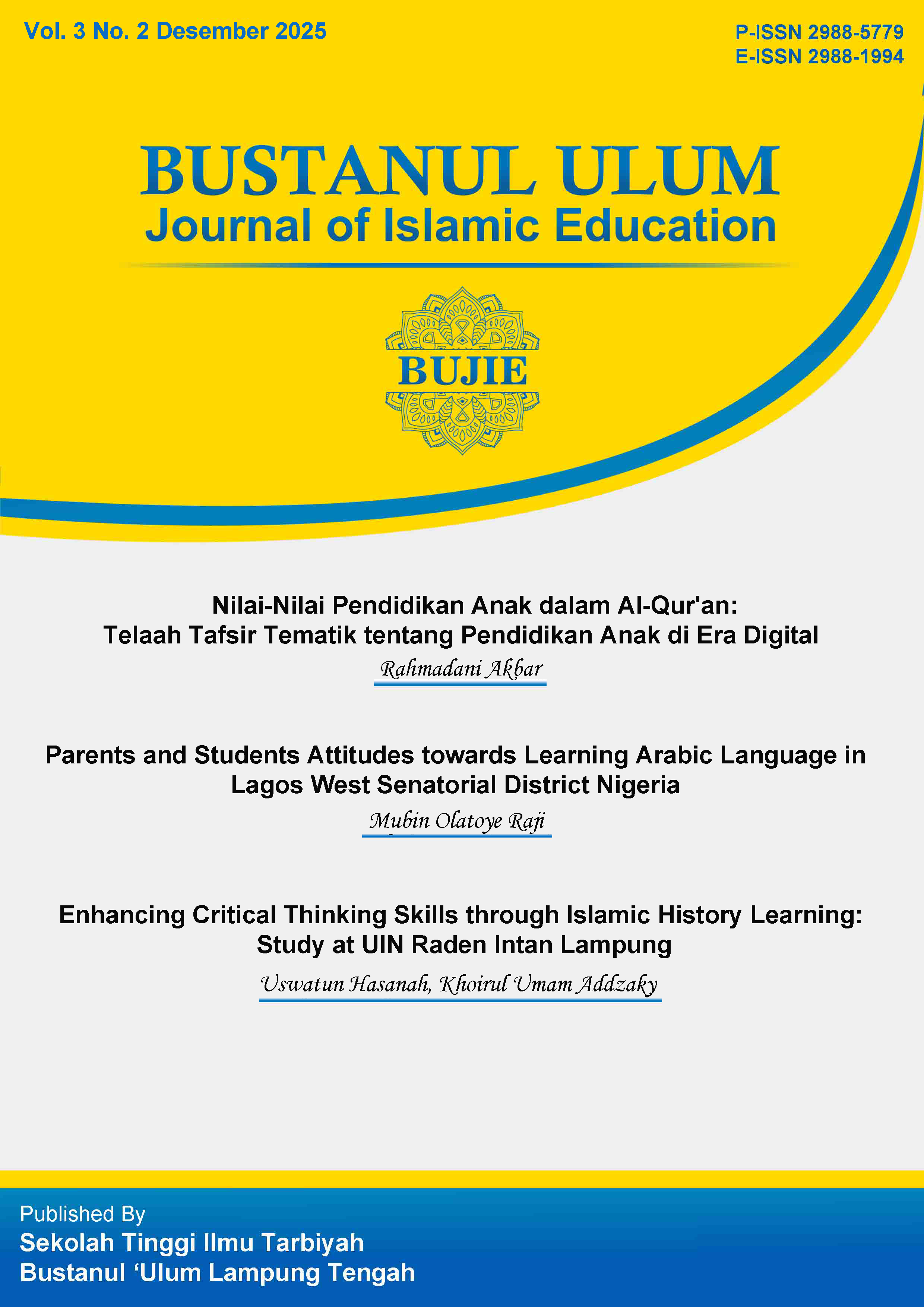
Parents and Students Attitudes towards Learning Arabic Language in Lagos West Senatorial District Nigeria
DOI:
https://doi.org/10.62448/bujie.v3i2.355Keywords:
Parents Attitudes, Students Attitudes, Arabic Learning, NigeriaAbstract
Arabic language education occupies a unique place in Nigeria, particularly in Lagos West Senatorial District, where cultural diversity and religious plurality shape educational choices. As a language with deep religious, cultural, and economic significance for Muslims, Arabic remains both a spiritual and practical asset. However, parents’ and students’ attitudes significantly influence its uptake in formal schooling. This study aims to investigate the perceptions, motivations, and barriers surrounding Arabic learning among junior secondary school students and their parents in Lagos West, with the broader goal of informing educational policy and planning. Adopting a descriptive survey design, the study combined quantitative and qualitative approaches. A stratified random sample of 150 junior secondary students was drawn from Education Districts 5 and 6, while parents were engaged through structured interviews. Data were collected using a researcher-developed questionnaire, analyzed with descriptive statistics (frequency, percentage, and mean ratings), and tested with inferential methods including t-tests and ANOVA at the 0.05 significance level. Findings indicate that students generally value Arabic for its role in religious development and career opportunities, while parental attitudes are more ambivalent, often influenced by competing educational priorities and varying perceptions of Arabic’s socio-economic relevance. The study concludes by highlighting the need for culturally sensitive policies and targeted awareness strategies to strengthen Arabic language education in Lagos West Senatorial District
Downloads
References
Abdullahi, Musa Siddiq. “Arabic Students’ Perception of the Roles of Arabic Education in Sustainable Development in Kwara State, Nigeria.” Kashere Journal of Education 2, no. 1 (2021): 63–70. https://doi.org/10.4314/kje.v2i1.
Abdullahi, Musa Siddiq, and Abdul Ganiy Abdus Salaam Oladosu. “Relationship between Students’ Learning Outcomes in WAEC and NECO Arabic Language Examinations in North-Central Nigeria.” International Journal of Islamic Educational Psychology 2, no. 2 (2021): 127–41. https://doi.org/10.18196/ijiep.v2i2.12324.
Abubakar, Salisu, Nuhu Baraka Tahir, and Hauwa Rabiu Musa. “Impact of Improvised Instructional Materials in Teaching and Learning of Biology among School Students in Jema’a Local Government Area.” ATBU Journal of Science, Technology and Education 11, no. 4 (2024): 307–16.
Abuhamdia, Zakaria. “Speech Diversity and Language Unity: Arabic as an Integrating Factor.” In The Politics of Arab Integration, 33–53. Routledge, 2015.
Adeniyi, Mr Shittu Morufudeen, Ibrahim Ali Allafiajiy, and Ahmad Tijani Surajudeen. “Revitalization of Arabic Education in the Nigerian Tertiary Institution of Learning in Yoruba Land: Entrepreneurship Education a Panacea.” US-China Foreign Language 14, no. 3 (2016): 190–97. https://doi.org/10.17265/1539-8080/2016.03.003.
Adeyemi, K A. “Learning Arabic as a Second Language and Its Importance in Nigeria.” Journal of Research in Education and Society. International Perspective 4, no. 1 (2013): 89–93.
Ajape, Kazeem Oluwatoyin, Arifin Mamat, and Yusuf Abdul Azeez. “Students’ Motivation and Attitude towards the Learning of Arabic Language: A Case Study of Arabic Students in Nigerian Universities.” International Journal of Economics and Financial Issues 5, no. 1 (2015): 122–27. https://doi.org/10.31436/ijes.v3i1.59.
Ajape, Kazeem Oluwatoyin, and Morufudeen Adeniyi Shittu. “Language Needs Analysis Of Arabic Language Students In Nigerian Universities: Quantitative Paradigm Method.” Alimi Journal Of Arabic Studies 5, no. 1 & 2 (2024).
Coe, Robert, Michael Waring, Larry V Hedges, and Laura Day Ashley. Research Methods and Methodologies in Education. SAGE Publications Limited, 2025.
Dogara, Ja’afaru Yusuf, and Hamidin Abd Hamid. “A Critical Discourse Of The Impact Of The Trans-Saharan Trade And The 19th-Century Jihad On The History Of Akwanga Division, Nigeria.” SEJARAH: Journal of the Department of History 30, no. 1 (June) (2021). https://doi.org/10.22452/sejarah.vol30no1.3.
Garba, Ahmad. “Brief Reflections on The Obstacles and Solutions Towards Arabic Language Through The Nigerian Literary Ages: A Historical and Descriptive Study.” Dzil Majaz: Journal of Arabic Literature 1, no. 2 (2023): 69–84. https://doi.org/10.58223/dzilmajaz.v1i2.45.
Gbodofu, Khalil Mohammad Usman. “The Current Status of Arabic Language Teaching in Nigeria: Challenges and Developments: SECOND LANGUAGE TEACHING.” Al-Ḍād Journal 6, no. 2 (2022): 13–29. https://doi.org/10.22452/aldad.vol6no2.2.
Olaniyan-Shobowale, K O. “Students’ Perceptions of The Arabic Language Curriculum.” International Journal of Innovative Research and Advanced Studies (IJIRAS) 3 (2016): 132–36.
Raji Isah Aliyu; Adam, Ibrahim Mukhtar; Murtala Abdurrashid. “Effectiveness of E-Learning Mode for Developing Arabic Language Skills for Non-Arab Speakers in Nigeria: An Empirical Study on FCE Katsina Students.” Journal of Innovative Research 2, no. 3 (2024): 7–14. https://doi.org/10.54536/jir.v2i3.3317.
Sirajudeen, Adam Adebayo, and Ahmad Rufai Aminullahi. “واقع تعليم اللغة العربية وتعلّمها في نيجيريا وقضية اتجاهات جديدة: Indeed, Teaching the Arabic Language and Learning It in Nigeria Is a New Trend.” SIBAWAYH Arabic Language and Education 4, no. 2 (2023): 1–11. https://doi.org/10.37134/sibawayh.vol4.2.1.
Solahudeen, Owoyale-Abdulganiy Ibrahim, Yahya Isiaq Oluwatosin, Babatunde Nurudeen ISSA, and Aliyu Shehu Babatunde. “Attitude of Islamic Studies Students towards Learning Arabic Language in Secondary Schools in Asa Local Government, Kwara State.” NPRC Journal of Multidisciplinary Research 2, no. 2 (2025): 197–210. https://doi.org/10.3126/nprcjmr.v2i2.76204.
Solahudeen, Owoyale-AbdulGaniy Ibrahim, Suleiman Yusuf, and Jimoh Kazeem Olanrewaju. “Challenges Associated With the Teaching of Arabic Language in Nigerian Secondary Schools: Implications For Stakeholders.” Jurnal Educatio FKIP UNMA 8, no. 4 (2022): 1489–97. https://doi.org/10.31949/educatio.v8i4.3167.
Downloads
Published
How to Cite
Issue
Section
License
Copyright (c) 2025 Mubin Olatoye Raji

This work is licensed under a Creative Commons Attribution-ShareAlike 4.0 International License.