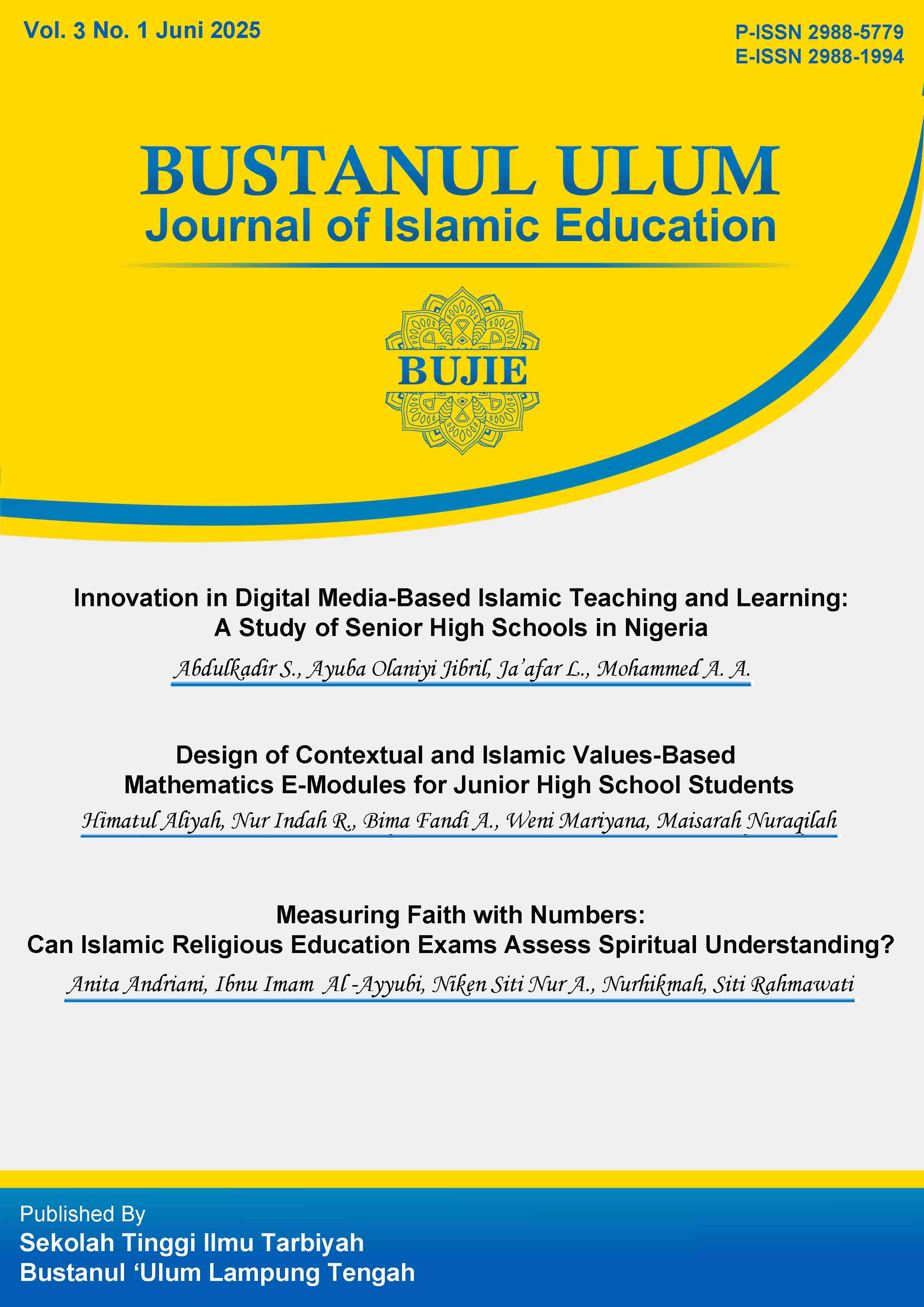
Design of Contextual and Islamic Values-Based Mathematics E-Modules for Junior High School Students
DOI:
https://doi.org/10.62448/bujie.v3i1.171Keywords:
E-Module Design, Mathematics Learning, Islamic Values, Digital MediaAbstract
This research aims to (1) Understand the contextual-based mathematics learning process and current Islamic values. (2) Produce a contextually based Mathematics E-Module product design and Islamic values in Class VIII SPLDV material carried out by the Batanghari Islamic Qurani Middle School. The type of research used is research and development (Research and Development) using the ADDIE model, which consists of 5 stages. The research subjects were 13 students in class VIII of SMP Islam Qurani Batanghari. Data collection techniques in this research used interviews, questionnaires, and documentation. The data obtained is the validity and practicality of the product. The results of this research identified that there is no innovation in the learning process in learning methods that only use general methods, namely lecture, discussion, demonstration, and memorization. Our teaching materials also include student worksheets (LKS) and teacher handbooks. Then, this study produced a product in the form of a contextually based Mathematics E-Module and Islamic values , which received the predicate of validity with an average score of 91%, and practicality based on student response questionnaires with an average score of 87% with very practical criteria. Based on this study, it can be concluded that the Mathematics E-Module based on contextual and Islamic values in SPLDV Class VIII material at Islamic Middle School Qurani Batanghari is suitable for use as teaching material in junior high schools.Downloads
References
Agung Heru Setiadi, Mahbub Humaidi Aziz, Moh. Ainin, Abdul Wahab Rosyidi, Bima Fandi Asy’arie, and Zainul Fuat. “Design of Heyzine Flipbook Based Arabic E-Module as an Alternative Teaching Material for Basic’s Level.” An Nabighoh 26, no. 2 (October 18, 2024): 195–216. https://doi.org/10.32332/an-nabighoh.v26i2.195-216.
Andi Rustandi, and Rismayanti. “Penerapan Model ADDIE Dalam Pengembangan Media Pembelajaran Di SMPN 22 Kota Samarinda.” JURNAL FASILKOM 11, no. 2 (August 26, 2021): 57–60. https://doi.org/10.37859/jf.v11i2.2546.
Arnes, Amelia, Muspardi Muspardi, and Yusmanila Yusmanila. “Analisis Pemanfaatan Platform Merdeka Mengajar Oleh Guru PPKn Untuk Akselerasi Implementasi Kurikulum Merdeka.” Edukatif: Jurnal Ilmu Pendidikan 5, no. 1 (January 24, 2023): 60–70. https://doi.org/10.31004/edukatif.v5i1.4647.
Asrori, Mohammad, Bima Fandi Asy’arie, Akhirudin, Ganjar Yusup Sofian, Ahmad Fadhel Syakir Hidayat, Aidillah Suja, and Roibin. “Islamic Educational and Cultural Values in Indonesian Puppetry Art: A Systematic Literature Review.” Cogent Education 12, no. 1 (December 31, 2025): 1–19. https://doi.org/10.1080/2331186X.2025.2490445.
Asy’arie, Bima Fandi. “Tik-Tok Application: Development Of Achievement Learning To Increase Interest In Learning At Madrasah Aliyah Negeri 1 Lampung Timur.” At-Turats 17, no. 2 (December 22, 2023): 129–45. https://doi.org/10.24260/at-turats.v17i2.2779.
Bima Fandi Asy’arie, Weni Mariyana, Fauzi Nadziiran Haq, Muhammad Syihab As’ad, Dimas Aditia. “Use of Social Media in Schools and Madrasas: A Systematic Review of Social Studies Learning Innovations.” Southeast Asian Journal of Islamic Education 7, no. 2 (2024): 31–54. https://doi.org/https://doi.org/10.21093/sajie.v7i2.9051.
Branch, Robert Maribe. Instructional Design: The ADDIE Approach. Boston, MA: Springer US, 2009. https://doi.org/10.1007/978-0-387-09506-6.
Citra Ayu Dewi, Citra, Maria Erna, Martini, Ikhfan Haris, and I Nengah Kundera. “The Effect of Contextual Collaborative Learning Based Ethnoscience to Increase Student’s Scientific Literacy Ability.” Journal of Turkish Science Education 18, no. 3 (September 28, 2021): 525–41. https://doi.org/10.36681/tused.2021.88.
Faris Fathurrohman, Mahrus As’ad, Widhiya Ninsiana, Bima Fandi Asy’arie, and Al-Mahdi. “Utilization of the YouTube Application in Learning Akidah Akhlak at Senior High School.” Bustanul Ulum Journal of Islamic Education 2, no. 2 (December 29, 2024): 112–35. https://doi.org/10.62448/bujie.v2i2.99.
Harefa, Darmawan, and Fatolosa Hulu. “Mathematics Learning Strategies That Support Pancasila Moral Education: Practical Approaches For Teachers.” Afore : Jurnal Pendidikan Matematika 3, no. 2 (October 27, 2024): 51–60. https://doi.org/10.57094/afore.v3i2.2299.
Khojir, Khojir, Ifah Khoirunnikmah, and Nela Syntha. “Teknologi Sebagai Media Pembelajaran Pendidikan Agama Islam Di Era Revolusi Industri 4.0.” El-Buhuth: Borneo Journal of Islamic Studies 5, no. 1 (December 30, 2022): 65–77. https://doi.org/10.21093/el-buhuth.v5i01.4373.
Muhammad Ridho Fatkhul Humam, MulyaPutra, Mahbub Humaidi Aziz, Bima Fandi Asy’arie. “Transformative Leadership of School Principals in Improving the Quality of Education from an Islamic Perspective.” AL-FAHIM: Jurnal Manajemen Pendidikan Islam 6, no. 4 (2024): 343–268. https://doi.org/https://doi.org/10.54396/alfahim.v6i2.1457.
Mutanaffisah, Rusyda, Resmi Ningrum, and Ari Widodo. “Ketepatan Pemilihan Pendekatan, Metode, Dan Media Terhadap Karakteristik Materi IPA.” Jurnal Inovasi Pendidikan IPA 7, no. 1 (July 24, 2021): 12–21. https://doi.org/10.21831/JIPI.V7I1.32622.
Nasrulloh, Iman, Nurdin Ibrahim, and Etin Solihatin. “Improving Mathematical Problem-Solving Skills through the Development of Interactive Digital Modules.” Mosharafa: Jurnal Pendidikan Matematika 13, no. 1 (October 6, 2024): 17–28. https://doi.org/10.31980/mosharafa.v13i1.1972.
Nurdiansyah, Ahmad Rifai, Yaya Sukjaya Kusumah, and Bambang Avip Priatna. “The Development of Website-Based Faimathematics in Mathematics Learning to Increase Student Learning Interest.” Jurnal Analisa 9, no. 2 (December 30, 2023): 122–37. https://doi.org/10.15575/ja.v9i2.27652.
Nursupiamin, Nursupiamin, Rafiq Badjeber, and Bagus Bagus. “Development of an Introduction to Basic Mathematics Textbook Integrated with Islamic Values.” Al-Khwarizmi : Jurnal Pendidikan Matematika Dan Ilmu Pengetahuan Alam 11, no. 1 (March 30, 2023): 83–102. https://doi.org/10.24256/jpmipa.v11i1.3025.
Padil, Moh., Bima Fandi Asy’arie, Syatria Adymas Pranajaya, Afif Alfiyanto, Dedi Wahyudi, Mahdi Mahdi, Aji Wahyudin, and M. Fahim Tharaba. “Political Exploration and Islamic Education Methods in Indonesia: A Systematic Literature Review in the Perspective of Sustainable Development Goals (SDGs).” Journal of Posthumanism 5, no. 3 (April 12, 2025): 1014–1041. https://doi.org/10.63332/joph.v5i3.839.
Rahmawati, Fitri. “Kecenderungan Pergeseran Pendidikan Agama Islam Di Indonesia Pada Era Disrupsi.” TADRIS: Jurnal Pendidikan Islam 13, no. 2 (December 10, 2018): 247. https://doi.org/10.19105/tjpi.v13i2.1752.
Riduwan. “Dasar-Dasar Statistika,” 39. Bandung: Alfabeta, 2015.
Roth, R., P. Ajithkumar, G. Natarajan, K. Achuthan, P. Moon, H. Zinzow, and K. Chalil Madathil. “A Study of Adolescents’ and Young Adults’ TikTok Challenge Participation in South India.” Human Factors in Healthcare 1 (December 1, 2021): 100005. https://doi.org/10.1016/j.hfh.2022.100005.
Rusdi, Muhammad. Penelitian Desain Dan Pengembangan Kependidikan. Depok: PT Rajagrafindo Persada, 2018.
Satriani, Rafika Dewi, and Lantip Diat Prasojo. “The Effectiveness of Website-Assisted Learning Multimedia to Improve Mathematics Learning Achievement of Elementary School Students.” Journal of Integrated Elementary Education 4, no. 2 (September 30, 2024): 120–35. https://doi.org/10.21580/jieed.v4i2.21523.
Septiani Selly Susanti, Laila Nursafitri, Iri Hamzah, Rita Zunarti, Darmanto, Fitriyah, Bima Fandi Asy’arie, and Muhammad Syihab As’ad. “Innovative Digital Media in Islamic Religious Education Learning.” Jurnal Pendidikan Agama Islam 21, no. 1 (June 30, 2024): 40–59. https://doi.org/10.14421/jpai.v21i1.7553.
Sulastri, Yayu Laila, Deti Ahmatika, Selma Auliya, Anisa Septriani, Elsa Elsa, Najlaa Kania Khaerunnisa, and Rachma Sundhari. “Development of Notion-Assisted e-Modules for Enhancing Mathematical Communication in Vocational High Schools.” Union: Jurnal Ilmiah Pendidikan Matematika 12, no. 2 (August 3, 2024): 443–58. https://doi.org/10.30738/union.v12i2.17250.
Sutisna, M R, Y Yuniarti, H Windayana, and H Hendriyana. “Design of a Web-Based Digital Learning Resource Center to Assist Online Learning with Mathematics Content in Primary Schools.” Journal of Physics: Conference Series 1987, no. 1 (July 1, 2021): 012005. https://doi.org/10.1088/1742-6596/1987/1/012005.
Tamur, M, E Jehadus, F Nendi, K Mandur, and V Murni. “Assessing the Effectiveness of the Contextual Teaching and Learning Model on Students’ Mathematical Understanding Ability: A Meta-Analysis Study.” Journal of Physics: Conference Series 1657, no. 1 (October 1, 2020): 012067. https://doi.org/10.1088/1742-6596/1657/1/012067.
Taufik, Ahmad. “Analisis Karakteristik Peserta Didik.” EL-Ghiroh 16, no. 01 (February 25, 2019): 1–13. https://doi.org/10.37092/el-ghiroh.v16i01.71.
Thahir, Musa, Yenita Roza, and Atma Murni. “Website Design of Capita Selekta Mathematics Course for Mathematics Education Students.” Journal of Physics: Conference Series 1470, no. 1 (February 1, 2020): 012092. https://doi.org/10.1088/1742-6596/1470/1/012092.
Ulum, Anharul, Ahmad Rozi Ride, M Kamil Salas, Bima Fandi Asy’arie, Adam Hafidz, and Al Fajar. “Humanistic Education Perspective of the Qur’an and Hadith.” AL QUDS : Jurnal Studi Alquran Dan Hadis 8, no. 2 (August 25, 2024): 378–92. https://doi.org/http://dx.doi.org/10.29240/alquds.v8i2.7806.
Yetti. “Peningkatan Kemampuan Guru Dalam Memilih Model Pembelajaran Melalui Workshop Di SMA Negeri 1 Sunggal Kabupaten Deli Serdang.” Jurnal Serunai Administrasi Pendidikan 10, no. 1 (April 13, 2021): 10–15. https://doi.org/10.37755/JSAP.V10I1.376.
Downloads
Published
How to Cite
Issue
Section
License
Copyright (c) 2025 Himatul Aliyah, Nur Indah Rahmawati, Bima Fandi Asy'arie, Weni Mariyana, Maisarah Nuraqilah

This work is licensed under a Creative Commons Attribution-ShareAlike 4.0 International License.