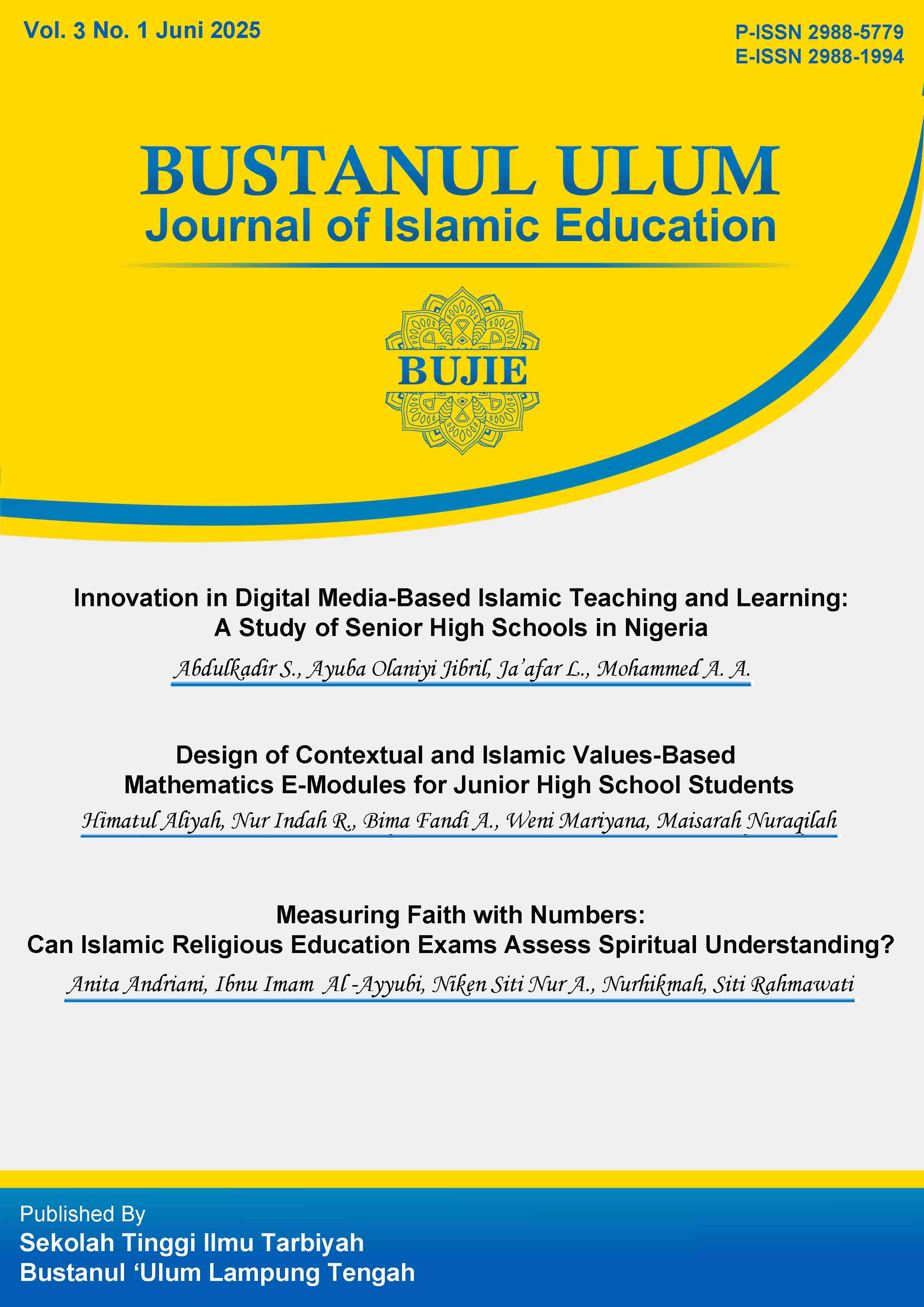
Measuring Faith with Numbers: Can Islamic Religious Education Exams Assess Spiritual Understanding?
DOI:
https://doi.org/10.62448/bujie.v3i1.170Keywords:
Faith, Spiritual Understanding, AssessmentAbstract
This study aims to evaluate whether numerical results from IRE exams can accurately reflect students' overall spiritual comprehension. Through both quantitative and qualitative analysis, the study finds that relying solely on test scores is insufficient to assess students’ faith and spiritual insight. Significant differences in learning outcomes between schools suggest that variations in teaching methods and assessment systems contribute to these disparities. Interviews with students and teachers reveal that IRE exams, which tend to emphasize memorization, fall short in uncovering deeper understanding of religious values. In contrast, assessment approaches that are more relevant to everyday life, encourage reflection, utilize narrative methods, and observe student behavior are perceived as more effective. Therefore, an ideal model for assessing Islamic Religious Education should integrate both cognitive evaluation and spiritual reflection through a comprehensive, holistic approach. By combining written assessments with contextual inquiry, personal reflection, and behavioral observation, educators can gain a more accurate and authentic picture of students’ religious understanding. Such a multifaceted evaluation system not only enhances the relevance of PAI but also supports the formation of students who genuinely embody Islamic values in their daily lives.
Downloads
References
Akhyar, Aidil, Hasbiyallah Hasbiyallah, Aan Hasanah, Hasan Basri, and Uus Ruswandi. “Impact of Teacher Welfare on Improving the Quality of Islamic Religious Education.” Ta Dib : Jurnal Pendidikan Islam 10, no. 1 (2021): 61–72. https://doi.org/10.29313/tjpi.v10i1.7583.
Anshori, Afif, Nur Amalia Solikhah, Dana Rosyidal Aqli, M Ali Musyafa, and Sigit Apriyanto. “Dynamics and New Paradigm of Islamic Education in Indonesia.” Scaffolding: Jurnal Pendidikan Islam Dan Multikulturalisme 4, no. 2 (2022): 232–45.
Anurogo, Dito, Hardin La Ramba, Nabila Diyana Putri, and Ulfah Mahardika Pramono Putri. “Digital Literacy 5.0 to Enhance Multicultural Education.” Multicultural Islamic Education Review 1, no. 2 (2023): 109–79. https://doi.org/https://doi.org/10.23917/mier.v1i2.3414.
Aripin, Syamsul Aripin Syamsul, and Nana Meily Nurdiansyah. “Modernization of Education: A New Approach and Method in Learning Islamic Religious Education.” TADRIS: Jurnal Pendidikan Islam 17, no. 1 (2022): 100–117. https://doi.org/https://doi.org/10.19105/tjpi.v17i1.5916.
Arnani, Ni Putu Rizky. Statistika Non Parametrik Konsep Dan Aplikasi SPSS. Lakeisha, 2024.
Arsyad, Arsyad, Wahyu Bagja Sulfemi, and Tia Fajartriani. “Penguatan Motivasi Shalat Dan Karakter Peserta Didik Melalui Pendekatan Pembelajaran Kontekstual Pada Mata Pelajaran Pendidikan Agama Islam.” POTENSIA: Jurnal Kependidikan Islam 6, no. 2 (2020): 185. https://doi.org/10.24014/potensia.v6i2.9662.
Bryman, Alan, and Duncan Cramer. Quantitative Data Analysis with IBM SPSS 17, 18 & 19: A Guide for Social Scientists. Routledge, 2012.
Bukhori, Hadi Ahmad, and Ibnu Imam Al Ayyubi. “Hubungan Hasil Belajar Mata Pelajaran Pendidikan Agama Islam Dengan Perilaku Siswa Di SMPN 3 Cihampelas KBB.” Al-Mubin; Islamic Scientific Journal 6, no. 1 (2023): 17–30. https://doi.org/https://doi.org/10.51192/almubin.v6i01.425.
Creswell, John W. “Research Design: Pendekatan Kualitatif, Kuantitatif, Dan Metode Campuran.” Diterjemahkan Oleh Achmad Fawaid, Edisi Ke-3. Cet. Ke-1. Yogyakarta: Pustaka Setia, 2010.
Darma, Wa. “Discovery Learning Method in Improving Learning Outcomes of Islamic Religious Education (A Study at SMKN 1 Baubau).” APLIKATIF: Journal of Research Trends in Social Sciences and Humanities 1, no. 2 (2022): 165–80. https://doi.org/10.59110/aplikatif.v1i2.133.
Fauzi, Helmi Al Hafid, Wahyu Hidayat, Ibnu Imam Al Ayyubi, Nurhikmah, and Raed Awadh Saeed Al-Ghatnaini. “Work Stress Levels At Madrasah Tsanawiyah Arrukhshatul’ulum: The Challenges of Digitalization in Developing Islamic Educational Institutions.” Mudir: Jurnal Manajemen Pendidikan 7, no. 1 (2025): 19–27. https://doi.org/https://doi.org/10.55352/mudir.v7i1.1469.
Firdaus, Muhammad Mirza. “Challenges and Opportunities of Higher Education Based on Islamic Boarding Schools.” In Indonesian Proceedings and Annual Conference of Islamic Education (IPACIE), 1:437–44, 2022. https://prosiding.uit-lirboyo.ac.id/index.php/psnp/article/view/108.
Hamruni. “Konsep Dasar Dan Implementasi Pembelajaran Kontekstual.” Jurnal Pendidikan Agama Islam XII, no. No. 2 (2015): 177–87.
Hanif, Muh. “Philosophical Review of Avicenna’s Islamic Education Thought.” Asian Journal of Engineering, Social and Health 2, no. 6 (2023): 1–16. https://doi.org/https://doi.org/10.46799/ajesh.v2i6.71.
Hejnová, Eva, Petr Eisenmann, Lucie Loukotová, and Jiří Přibyl. “Pupils’ School Performance and Their Cognitive Abilities to Solve Problems.” Journal on Efficiency and Responsibility in Education and Science 17, no. 1 (2024): 55–66. https://doi.org/https://doi.org/10.7160/eriesj.2024.170105.
Kemenag RI. Al-Qur’an Dan Terjemahannya. Lajnah Pentansihan Mushaf Al-Qur’an, Badan Litbang Dan Diklat Kementerian Agama RI. Vol. 11, 2019.
Khallaf, Shkuria Mahmoud. “The Role of Scientific Miracles in Defending the Islamic Faith.” Bilad Alrafidain Journal of Humanities and Social Science 5, no. 1 (2023). https://www.iasj.net/iasj/article/283810.
Khasanah, Hilda Amalia, Kustiono Kustiono, and Samsudi Samsudi. “Development of Power Point Macro-Based Interactive Multimedia in Learning Islamic Cultural History in Improving Student Learning Outcomes.” Innovative Journal of Curriculum and Educational Technology 12, no. 1 (2023): 37–47. https://doi.org/10.15294/ijcet.v12i1.71256.
Koopman, Jop. “Subawe, Traditional Knowledge, and Faith-Based Organisations Promoting Social Capital and Disaster Preparedness: A Lombok, Indonesia Case Study.” International Journal of Disaster Risk Reduction 94 (2023): 103837. https://doi.org/https://doi.org/10.1016/j.ijdrr.2023.103837.
Murharyana, Murharyana, Ibnu Imam Al Ayyubi, and Rifqi Rohmatulloh. “Pendidikan Akhlak Anak Kepada Orang Tua Dalam Perspektif Al-Quran.” Piwulang: Jurnal Pendidikan Agama Islam 5, no. 2 (2023): 175–91. https://doi.org/http://dx.doi.org/10.32478/piwulang.v5i2.1515.
Murharyana, Murharyana, Ibnu Imam Al Ayyubi, Rifqi Rohmatulloh, and Shoutika Nawadya Ikromi. “The Effects of Islamic Religious Education Learning on Students’ Motivation.” At-Tadzkir: Islamic Education Journal 3, no. 1 (2024): 1–14. https://doi.org/https://doi.org/10.59373/attadzkir.v3i1.44.
Murharyana, Murharyana, Ibnu Imam Al Ayyubi, Rifqi Rohmatulloh, and Irfan Suryana. “Behavior Change of Darul Falah Senior High School Students After Attending Tabligh Akbar.” Dirasah International Journal of Islamic Studies 1, no. 2 (2023): 68–77. https://doi.org/https://doi.org/10.59373/drs.v1i2.17.
Mustamin, Mustamin, Syamsudduha Saleh, Abd Rahim Razak, Ilham Muchtar, and Suriyati Suriyati. “Islamic Educational Values in Local Wisdom Traditional Tradition of Mappogau Sihanua Karampuang Sinjai District.” IJORER: International Journal of Recent Educational Research 4, no. 2 (2023): 188–202. https://doi.org/https://doi.org/10.46245/ijorer.v4i2.326.
Mutaqin, Mumu Zainal, Dirga Ayu Lestari, Solihin Solihin, Ibnu Imam Al-Ayyubi, and Siti Rahmawati. “Factors in Religious Culture to Increase Tolerant Attitude of Gen-Z Among Urban Muslims.” Akademika: Jurnal Pemikiran Islam 29, no. 1 (2024): 73–86. https://doi.org/https://doi.org/10.32332/akademika.v29i1.9145.
Nasaruddin, A H, and S Ladiqi. “Digital-Based Islamic Religious Education (IRE) Learning Model at Senior High School.” … Journal of Islamic Education …, 2023. https://ejournal.uit-lirboyo.ac.id/index.php/ijies/article/view/3525.
Nurhidin, E. “Tolerance Education and Rejuvenation of Islamic Religious Education (IRE) Learning on Independent Curriculum.” Jurnal At-Tarbiyat: Jurnal Pendidikan Islam. scholar.archive.org, 2023. https://scholar.archive.org/work/yiy4qzenprbmpe7wyaqz6lkbcy/access/wayback/https://jurnal.staiannawawi.com/index.php/At-Tarbiyat/article/download/717/436.
Nurhikmah, and Eko Prayetno. “Equilibrium of Faith and Logic : Integration of Islamic Moral Values and Mathematics Education at the Junior High School Level in Various Contexts.” IJEMR: International Journal of Education Management and Religion 1, no. 2 (2024): 127–44.
Pancawardana, Haris, Ibnu Imam Al Ayyubi, Rifqi Rohmatulloh, and Murharyana Murharyana. “The Influence of Nonformal Education on Students’ Cognitive Formation.” KOLOKIUM Jurnal Pendidikan Luar Sekolah 11, no. 2 (2023): 236–43. https://doi.org/https://doi.org/10.24036/kolokium.v11i2.612.
Payne, D. A. The Assessment of Learning Cognitive and Affective. Lexington D. C.: Heath, 1974.
Prayetno, Eko, Ibnu, and Deden. “Student Tolerance Attitudes in Islamic Boarding Schools.” Southeast Asian Journal of Islamic Education 07, no. 02 (2024): 119–38.
Randall, Stephanie Elizabeth. Cognitive Conflict Levels between Middle School Students with Learning Disabilities and Students without Learning Disabilities. Liberty University, 2022.
Roy, Sudipta, Samia Huq, and Aisha Binte Abdur Rob. “Faith and Education in Bangladesh: A Review of the Contemporary Landscape and Challenges.” International Journal of Educational Development 79 (2020): 102290. https://doi.org/10.1016/j.ijedudev.2020.102290.
Rumainur, Rumainur, Umar Fauzan, and Noor Malihah. “Characteristics of Islamic Religious Education in Boarding School Curriculum.” Southeast Asian Journal of Islamic Education 4, no. 2 (2022): 197–207. https://doi.org/10.21093/sajie.v4i2.4593.
Sabarudin, Mohammad, Ibnu Imam Al Ayyubi, and Rifqi Rohmatulloh. “Metode Project-Based Learning Untuk Menumbuhkan Nilai-Nilai Pancasila.” AlMaheer: Jurnal Pendidikan Islam 1, no. 02 (2023): 15–22. https://journal.stitalazami.ac.id/index.php/almaheer/article/view/14.
———. “Strategi Pembelajaran PAI Berbasis Inkuiri Dan Kemampuan Berpikir Kritis Mahasiswa.” Kaffah: Jurnal Pendidikan Dan Sosio Keagamaan 2, no. 2 (2023): 84–92. https://jurnal.unmabanten.ac.id/index.php/kaffah/article/view/532.
Sabarudin, Mohammad, Ibnu Imam Al Ayyubi, Rifqi Rohmatulloh, and Siti Indriyani. “The Effect of Contextual Teaching and Learning Models on Al-Quran and Hadith Subjects.” At-Tadzkir: Islamic Education Journal 2, no. 2 (2023): 129–42. https://doi.org/https://doi.org/10.59373/attadzkir.v2i2.43.
Sabarudin, Mohammad, Ibnu Imam Al Ayyubi, Rifqi Rohmatulloh, Irfan Suryana, and Tommy Tanu Wijaya. “Exploring the Foundations of Islamic Education: Insights from Ibn Sina and Ibn Khaldun.” Tribakti: Jurnal Pemikiran Keislaman 35, no. 1 (2024): 127–42. https://doi.org/https://doi.org/10.33367/tribakti.v35i1.4266.
Sabarudin, Mohammad, Ibnu Imam Al Ayyubi, Irfan Suryana, Rifqi Rohmatulloh, and Saepulloh Saepulloh. “The Effect of the SAVI Learning Model on Arabic Writing Skills: A Case Study at MTS Arrukhsatul ‘Ulum, West Bandung.” Khulasah: Islamic Studies Journal 5, no. 2 (2023): 102–11. https://doi.org/https://doi.org/10.55656/kisj.v5i2.114.
Sasmita, Reni. “Character Education Metod From the Lens of Al-Ghazali on Generation Z.” EDUSOSHUM: Journal of Islamic Education and Social Humanities 2, no. 3 (2022): 121–30. https://doi.org/10.52366/edusoshum.v2i3.47.
Subiyantoro. “Faith and Social Character Education of Sociological Education Perspective: An Implementation of Classroom Management in Islamic School.” MANAGERIA Jurnal Manajemen Pendidikan Islam 2, no. 2 (2017).
Sugiyono. Metode Penelitian Kuantitatif Kualitatif Dan R&D. Bandung: Alfabeta, 2021.
Sulaeman, Jaja, Dedi Djubaedi, Eti Nurhayati, Siti Fatimah, and Didin Nurul Rosidin. “Islamic Religious Education Holistic-Integrative Learning in Elementary School.” International Journal of Social Science And Human Research 6, no. 3 (2023): 1724–33. https://doi.org/https://doi.org/10.47191/ijsshr/v6-i3-51.
Summeren, L F M van, A J Wieczorek, and ... “Community Energy Meets Smart Grids: Reviewing Goals, Structure, and Roles in Virtual Power Plants in Ireland, Belgium and the Netherlands.” Energy Research & …. Elsevier, 2020. https://www.sciencedirect.com/science/article/pii/S2214629619304335.
Supala, Supala, Dita Handayani, and Anwar Rifai. “Pendidikan Humanis Kh Ahmad Dahlan, Ki Hajar Dewantara Dan Paulo Freire.” THORIQOTUNA: Jurnal Pendidikan Islam 3, no. 2 (2020): 94–115. https://doi.org/https://doi.org/10.47971/tjpi.v3i2.287.
Susanti, Cela Petty, Rosendah Dwi Maulaya, and Fifi Nur Lynda Febriyani. “Implementasi Konsep Sistem Among Ki Hajar Dewantara Dalam Dinamika Pendidikan Pesantren Modern.” Shibghoh: Prosiding Ilmu Kependidikan UNIDA Gontor 1 (2023): 361–70. https://ejournal.unida.gontor.ac.id/index.php/shibghoh/article/view/9509.
Susanty, Adriani, Nur Laili Indasari, Herawati Oktavianty, Ibnu Imam Al Ayyubi, Dwi Amalia Purnamasari, Elda Yulia Ryandini, Hafidz Abdullah, Titik Inayati, Muhamad Ahsan, and Dwi Vernanda. Metode Penelitian Kualitatif. Malang: CV. Future Science, 2023.
Thrane, Christer. Doing Statistical Analysis: A Student’s Guide to Quantitative Research. Routledge, 2022.
Wenren, Shiqing, Wan Ding, Zhenliang Wang, Yue Xia, Ruibo Xie, and Weijian Li. “Reciprocal Effects between Reading Comprehension and Emotional Cognitive Ability.” Learning and Individual Differences 109 (2024): 102398. https://doi.org/https://doi.org/10.1016/j.lindif.2023.102398.
Downloads
Published
How to Cite
Issue
Section
License
Copyright (c) 2025 Anita Andriani, Ibnu Imam Al Ayyubi, Niken Siti Nur Apriyanti, Nurhikmah, Siti Rahmawati

This work is licensed under a Creative Commons Attribution-ShareAlike 4.0 International License.